Showing posts with label travel. Show all posts

Monday, 20 July 2015

Cardamon flan aka A happy accident

From avoiding sugar (with varying degrees of success) to full blown sugarholic. This is my journey. While everyone is on a healthy eating tip these days, with Helmsley&Helmsley and Deliciously Ella,  I appear to have gone the other way entirely in the last couple of months, whilst experimenting with cake and dessert recipes. Writing a cookbook and being  pregnant has given me the perfect reason (excuse?) to fall off the sugar-free wagon and on to a soft cloud of cream cakes and delicate meringue; bouncy doughnuts (I made these twice in the last fortnight) and an unexpected cardamon flan. The flan was a cream-cake-gone-wrong, a very happy accident indeed. Just like my pregnancy come to think of it. It was a taste I'd had before, somewhere in Spain - was it Andalucia or Barcelcona? I can't put my finger on it.  I've visited both numerous times and I wish I'd recorded more of the meals I'd eaten there, because they were some of the best I've ever had. So in summary, a flan similar to this was once eaten by yours truly sometime in the past in Spain. It was not cardamon though, and this ancient, aromatic spice is what makes my flan really special.
Can you see how soft and squigy it is inside? This is because it's based on a cardamon custard: heat 400ml of the milk, cream and cardamon pods slowly in a saucepan. Whisk the sugar and egg yolks together. Blend the cornflour with the remaining 100ml of milk and add to the eggs and carry on whisking. When the milk has come to the boil, take it off the heat for about 10min. Remove the pods and heat once again. Stir continuously until this mixture thickens, then place the pan in a sink of cold water to cool. Stir occasionally. Once the mixture is completely cold blend it with an electric blender or whisk while adding the butter and flour. Bake at 180 degrees C for about 50min.

Ingredients

500ml milk 
50ml single cream 
5 cardamon pods 
3 tablespoons cornflour 
4 egg yolks 
100g light cane sugar 
200ml butter 
150g flour

Tuesday, 17 February 2015

Mango lassies on Koh Lipe

I'm going to come clean straight away - this is a cheat post, because I'm not making or cooking anything here in Thailand. I'm also not eating bugs or anything else out of the ordinary. I am however drinking these mango lassies every single day.
That up there is the beach on Koh Lipe that I'm drinking them on (the quieter Sunrise Beach). If you want to make one of these healthy, refreshing, wonderful drinks this is what you need to blend: yellow mangos (much more flavour than their green counterparts), natural yoghurt, ice. That is all.

Friday, 14 November 2014

An Autumn stew with beans and pumpkin

I was in Athens the other day visiting my heavily pregnant friend and wanted to make a huge pot of something that we could eat for dinner, then freeze for the busy days ahead. It's getting a bit chillier, even in Greece, so I was thinking warming and substantial dishes, and of course, the French cassoulet came to mind. The last time I made it was in the French Alps, and we ate it with great joy and relief almost (as well as fresh baguette), after a day on the slopes. But this was Greece - a different climate, different ingredients, so I reworked the recipe to include some lovely pumpkin that we found at the market, two types of dried Greek beans (black eye beans and another type I didn't recognise), Greek sausage with leek (rather than the traditional French garlic sausage). I made the recipe skinnier not for health reasons but because of the temperate climate here, so gone is the duck confit and goose fat and in come more meditterean vegetables. The French bouquet garni was also replaced, with local, wild oregano. This isn't fusion cuisine; this is using local, seasonal produce and creating a new version of a dish, based on a classic
Soak the beans overnight, then cook them slightly before you start the stew - about 15 minutes of simmering in salted water, then drain. Fry the chopped sausages first, in some of the olive oil, then remove from the pan, Add the lardons and the chopped onion next, fry for a couple of minutes, then add the grated carrots, chopped celery (which, incidently, looks completely different in Greece) and keep frying on a low heat, stirring now and again. After about 5min add the tomatoes, beans, white wine, garlic, herbs and spices. Bring to the boil then turn the heat down again and allow to simmer for about 10min or until the tomatoes start to disintergrate. Add some water and put the sausage back in the dish. Allow to simmer for about 45min, before adding the pumpkin and more wine/water if needed. After another 45min season the stew with plenty of salt pepper and taste. Perhaps it needs more paprika or oregano? I'd give it another half an hour on top of that before serving with crusty bread - so 2 hours of cooking time in total. The ingredients down there are approximate, as usual, so just experiment with the flavours and go with the flow

Ingredients - makes about 10 portions

1/4 large pupkin, roasted for 20min, peeled and chopped
6-8 leek sausages, chopped into bitesize pieces
200g lardons
1.5kg dried beans (2 types)
Bunch of celery (Greek celery is much thinner, so probably about 6 stalk of British celery)
3 red onions, chopped finely
4-6 cloves of garlic, chopped or crushed
10 large tomatoes, peeled and chopped
6-8 carrots, grated
1 tablespoon dried, wild oregano (if available)
1 teaspoon paprika
4 bay leaves
Half a bottle of white wine
Salt and pepper
Mild olive oil
Chilli flakes and crusty bread to serve

Saturday, 10 May 2014

Greek feta cheese pie

I have brought you a little gift from Greece - cheese pie. This recipe belongs to Vaso's mum, but I have had to adapt it slightly to suit UK ingredients
Make the filling by squishing the feta and lightly beaten eggs together. Add black pepper and squish some more (I did this with my hands but feel free to use a fork or any other squishing device), until it's nearly smooth, then grate the cheddar in. The pastry here is different to the Greek stuff. I used the pre-rolled sheet and rolled it out even more on a floured surface, until it really couldn't get any thinner. It was 60cm in length and I cut it into four equal strips. Take three of the strips, oil them and lay on top of one another on some foil. Place the filling on top, flatten and cover with the last sheet. The original recipe calls for 6 layers at the bottom and 5 on top, but this is not possible with this pastry. If you make your own or find the super thin sheets (I have since found out that you search for these in the freezer) then you can try it. You could use two sheets of the pre-rolled stuff, but it will make it too pastry heavy in my opinion. Fold all the sides and corners in, sticking them together with oil, before baking in a pre-heated oven at 180 degrees C for around an hour
Greece was magical as always. I must have been to Greece about a dozen times over the years and each time it leaves me with unforgettable memories and a hankering for more. Always that same herby smell, the connection to antiquity, the warmth of the people and the air. I started off in and around Athens, spending quality time with my beloved old friend, Karina, her family and friends. In Oropos, I watched a breathtaking sunset, swam in the crystal Aegean and celebrated Easter with an egg fight; in Athens, I sunbathed on a massive terrace not far from the Acropolis, drank Greek wine here and delved deeper into the city. The delving brought immediate rewards as in Monastiraki, after years of dreaming about it, I found Stavros' the poet sandalmaker's shop where I bought a pair of the best Greek sandals in Greece
I met my new love on Mykonos. We visited the gods on Delos, got to know one another intensively and at times brutally, ending up in hospital on the last day. No we didn't beat one another up, thankfully, but we did crash the bike

Cheese Pie - Ingredients

1 sheet filo pastry, pre-rolled
400g feta
100g cheddar
2 eggs
Black pepper
Olive oil
Plain flour

Friday, 25 April 2014

Eating Greece

I'm in Greece doing non-specific, food-related research
That may sound like I'm just on holiday and eating a lot... which is partly true... But I'm also collecting recipes, which I will cook and tell you about when back home


Sunday, 29 December 2013

"Dobra Kasza Nasza" in Zakopane

Kasha ("kasza" in Polish), or grains, are such a common food stuff here that actually we have sayings about them. For example, a person may be described as someone who "doesn't let anyone blow on their kasha", meaning that they don't let anyone boss them around, or "take the piss" as we would charmingly say in the UK. There are many varieties of kasha and all are available in this restaurant in Zakopane, recommended to me by my old childhood friend, Iza, who writes this blog
Zakopane is the Winter capital of Poland, somewhere we have spent the past couple of Christmases, and a place that's popular all year round with tourists: full of cosy, wooden restaurants and hearty "mountain" food. If you are a keen skier or snowboarder, used to the likes of the Alps, you may not feel completely satisfied with the conditions here - the Tatra mountains, being a national park, have but one slope you can ski down (this was closed due to wind this year), so the main ski area is Białka Tatrzańska, a 30min drive away, in the direction of Kraków; apart from this it's just an odd slope here and there. However, it is well worth a visit, any time of the year, if only for the atmosphere. If you do find yourself in this magical little town, you may get tired of all the "mountain" food after a couple of days and this is why I would recommend "Dobra Kasza Nasza" - it's different to all the other restaurants in Zakopane, in food and ambiance alike
I would also strongly recommend the "kwaśnica" for starters, the Polish sauerkraut soup that in other parts of Poland goes by the name of "kapuśniak". The ribs are a tasty main if you're hungry, otherwise go for one of the baked kashas. I ordered the millet and pumpkin one you see up there, which was nice (not a very descriptive word, I know - it would be inaccurate to use anything stronger, yet it was "quite nice"). I would however go for something else next time, probably buckwheat based, as this is the kasha that I most associate with Poland and that I miss when I am out of the country. They also have a couple of delicious unpasteurized beers on tap

Friday, 11 October 2013

Salad with roast peppers, red onion and home-made croutons (Cooking for Simone part 2)

I have been traveling for ever now it seems like. Living out of a suitcase, waiting for delayed planes, lost luggage and suspected terrorists. Meeting friends in unlikely places, swimming in any bit of water I can find, whether it's a sea, ocean or an unexpected lake. Eating pastas and pizzas in Italy, oysters washed down by plenty of wine in Napa and San Francisco. Some tacos and beer too. Quite a few burgers. The last time I properly cooked was in LA, when I made healthy stuff for Simone and myself every day. This was a particularly well-turned-out salad with some of those small red and yellow peppers (they should be called baby peppers but they're not as far as I know), a large red onion I found lying around the fridge and some warm, crunchy home-made croutons. There is really nothing in the world like home-made croutons, I seriously must encourage to make them yourself
I cut the tiny peppers in two, took the seeds out and roasted them with the roughly chopped red onion, plenty of olive oil and some dried herbs (thyme and rosemary I believe it was). At the end of the roasting time (it should take about 40min in total) squeeze some lemon in. I picked my lemon straight from the tree in the garden - and this is one of the reasons why I would live in LA. I made the croutons by frying cubes of bread in very hot olive oil until brown on both sides. Then you need to take them out and drain them on some paper to remove excess oil, and add a bit of salt. Serve all this on a bed of lamb's lettuce and cherry tomatoes with your favourite vinaigrette. Unfortunately, Simone will not give me the recipe for her special vinaigrette, as she is convinced that one day she will bottle it and make her millions. She is probably right

Saturday, 21 September 2013

La Stella Marina di Montecristo, Cagliari: possibly the best fish meal in Sardinia

It's the second year in a row that I've ended up in Sardinia, so it's fair to say that I am a little bit in love the place. This time round, I was there for over two weeks. I went to a festival and travelled down the east coast with girlfriends. Last year it was the west coast with my ex, LT. They are completely different, both equally beautiful and in some way, magical. At least to me
One place I do not love in Sardinia in Cagliari. It's a large city in the south. There is nothing wrong with it per se, it's simply a bit underwhelming in comparison to the rest of the island. It is nevertheless where we ended up having the best meal of our entire trip, in a weird, little, kitch restaurant full of locals
It was recommended to us by Alberto, our host through Airbnb. It's always fish and it's always cheap. You eat what they give you, no menu. For a person who doesn't particularly enjoy making decisions and loves all food, like myself, it's heaven
I could take you through everything we ate, all the different types of fish and seafood, finished off with sweets, mirto and limocello, but as it is different every night, I think it would be quite pointless. Also, having returned from Sardinia last night, I have found out the my second beloved gran (the only one left) is not well, possibly on the way out, so I need to fly to Poland today. I'm writing this in the one hour I have before I go to the airport again, therefore I do not have time to focus on the details of this meal. I hope that you get the idea of what it was like from the pictures. All you really need to know is that if you are in the area, you should come here. You need to book ahead and the meal will set you back around 30 euros per head with wine. You pay at the till at the end, no faffling around with bills and tips

Sunday, 28 April 2013

A delicious detox: Two well-turned-out salads

When you start craving salads instead of sweets or steak, you know it's time for a detox. Unfortuntely, being on a detox in Poland is really hard work. I've been trying to avoid butter and sugar - really not a huge ask - and yet these two rules have been broken again and again during this ten day stay in my homeland. However, I have been being running, doing my kundalini kriya and eating fish religiously, every day, so that's something. And since we've been in our house in Warsaw instead of a hotel in Sopot, I've been making salads. Massive, satiating, killer salads. I must have been inspired by Paris
For this one, you need to prep by: firstly, frying an onion in some olive oil for about 7-8min, adding the beans, salt,pepper and cinnamon and frying until warm; and secondly, grilling the red pepper with olive oil, salt and chilli flakes for about 6-7min. The salad bed is torn lettuce and basil leaves, chopped tomatoes (we call these rasberry tomatoes here in Poland, not sure what they're called in the UK, but the have a rasberry-coloured hue), and chopped feta. On top, we have a light vinaigrette of olive oil, apple vinegar and lemon juice mixed together, buckwheat honey (this is a dark, strong-tasting variety), salt and white pepper
And for the second one, cook the fresh asparagus for about 5min in boiling water, so that they are still firm and a little bit crunchy. If they are the fat ones like those up there, you should either cut a couple of inches of the end off, or peel the ends. The bed is a curly, crunchy type of lettuce, blue cheese, walnuts and hard-boiled quails eggs, and the vinaigrette is a sweet one with a mxture of olive oil, balsamic vinegar, honey, salt and freshly ground black pepper. With both the vinaigrettes the ratio of oil to vinegar is 3-1, and I use a jar to shake all the ingredients together

Wednesday, 24 April 2013

Sunny Springtime bento plane lunch

As I've been on the road recently I haven't been cooking much, but I would like to show off this bento I made for my mum (and myself) for our plane journey to Gdańsk. When I was a child I used to love plane food. Probably the fact that I came from a communist country where shops often only had vinegar helped. But also aesthetically - I liked all the small compartments full of different kinds of food - and the spirit of adventure that accompanied it. You don't get these on shorthaul flights anymore, so rather than buying some soggy, half-arsed sandwich, it's more fun to eat a meal that brings back that sense of something special about to happen
So please meet my Sunny Springtime bento! For the main dish I sautèd some kale with garlic in a mixture of olive and pumpkin seed oil, grated some nutmeg over the top and added the cooked pasta.The salad on the side is a mixture of chickpeas, cherry tomatoes, chilli, coriander, lime juice and olive oil. So it's all really simple, healthy stuff and super easy to make. It's only about the fifth bento that I've made in my entire life, but I can really see myself getting into this

Thursday, 18 April 2013

Probably the best salads in Paris

Paris holds a special place in my heart. I have been here countless times, but our special relationship began when I was 19. I came here with my best friend for Valentine's Day and we met some Israeli guys. They were in Paris to meet a man prominent in the Church of Universal Energy. We spent the rest of our holiday learning about meditation and chakras. Even though I don't belong to any church or religion, as I see it this was the start of my journey towards a greater sense of awareness. Even though I have also been here with men in my life, I prefer Paris with girls. It's not a place of romance for me, but somewhere I come to reflect. And eat. And drink wine
Just off the trendy Rue Oberkampf, in Paris' Bastille district, there's a little Jazz bar and restaurant - this is what it's called but I can't find it online, the only other clue I can give you is that it has an aquarium- that has the best salads in Paris, perhaps even the world, I don't know. It depends of course on what your idea of a great salad is. If it's something that does not contain meat, then these salads may be a huge  disappointment
However, if you like to eat salad as a complete meal, and are not vegetarian, then you would probably feel the same way that I do. My one was full of goose gizzards and fois gras (I like to think it was the ethical variety, but since I eat it maybe once a year, I'm willing to forgive myself for feigning ignorance on this occasion), Magda's had goat's cheese stuffed pancake dumplings (it's the only way I can describe it) and parma ham. When we ordered our salads, the waitress actually told us that we ordered "les mieux". How lucky. They set the tone for the rest of our sun drenched, carefree weekend

Wednesday, 3 April 2013

Dokebi Korean restaurant in Williamsburg, Brooklyn

I've fallen in love with Williamsburg. It's incredibly hip but also open and friendly: the perfect combination. If you plan on hanging out here then I would recommend this Korean restaurant on Grand Street for a cheap, healthy and delicious meal... Dokebi
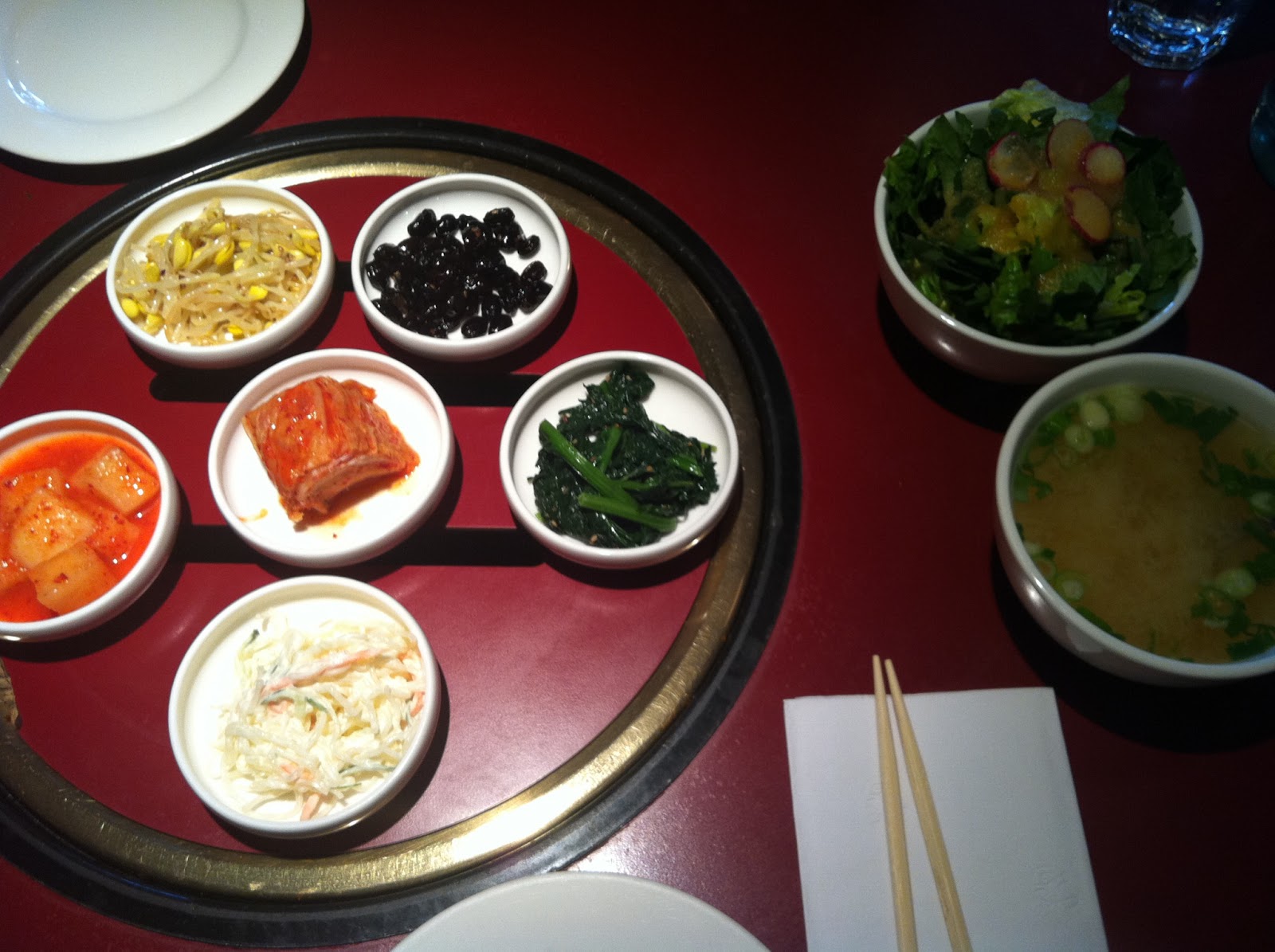
You may know what my reviews are like by now: short and sweet. So here's the lowdown: we ate Korean tacos, lots of pickles, salad and miso soup on the side and the BiBimBahp you see up there. The rib taco was the best out of the tacos, the fish one I wouldn't bother ordering again. Cat mixed the BiBimBahp up with the chilli sauce like you're supposed to and I washed it down with Korean rice wine - my new favourite drink (now, where do I get this in the UK...?) It all came to $17 each including the tip, so about £12. I think dinner may be a bit more expensive, as weekday lunches in NYC tend to be really cheap

Saturday, 16 March 2013

Food in Madrid - goose barnacles and cardoons

One of my favourite things about Madrid -  along with the fun people; a "clandestino" night club I found myself in at 8am that Sunday; and a massage here - is the food. Spanish food is everything I love - simple, unpretentious and natural. There were a few things that I ate while in Madrid that I've never eaten before, namely "percebes" and "cardo"
 I believe that this is what's called a "goose barnacle" in English. These are fussy, little sea creatures that only live on rocks where the waves break - because of this they are not easy to obtain and quite expensive. We were lucky enough to try them at the Mercado San Anton, when the clams we ordered were "not very well"
"Cardo" translates into English as "thistle" or "cardoon" and it looks like a massive celery. However, unlike celery, here you only eat the heart. I don't know why this appeals so much to me, but it does. Unai cooked it for me at home, with some other vegetables and I enjoyed it so much that I would like to share the recipe with you - this dish hails from the Basque Country, same as Unai. You can use it with any vegetables you like, especially artichoke - cardoon's relative. Cook the cardoon in water for about 15min. Fry the garlic and onion in oil until they are translucent, then add flour. Mix this while frying until it all turns brown. Now add a bit of water from the cardoon - about a ladle-full - and keep stirring and frying for another 8-10mins. Add the cardoon to the sauce, along with any other vegetables that take your fancy and the boiled eggs. Season and serve like this
Ingredients

Cardoons/other vegetables
Onion
Garlic
1 tablespoon flour
Eggs, hard-boiled
Olive oil
Salt and pepper

Wednesday, 9 January 2013

Herrings under a fur coat aka salad "pod shuboy"

I remember eating this salad for the first time in St Petersburg. It was in the same building that Pushkin had his last glass of water - or it could have been a lemonade, no one is sure - before he went off to his fateful duel. It's remarkable to think that, until relatively recently, that was a perfectly acceptable way to handle certain disputes. Especially those of the heart, it would seem. It' very... Russian, isn't it? So romantic, so elegantly blasé, even in the face of death. So incredibly glamorous.
And St. Petersburg is incredibly glamorous. And eating this salad, in an elegant cafe on Nevsky Prospect, I felt incredibly glamorous too. I hope that if you make it, it will do the same for you
The salad itself is supposed to look like a cake, colourful and layered. The beetroot, apple, potato, carrot, egg and herring are a fantastic combination, complementing one another at every opportunity. Once you've made this salad a few times, you will probably have your own way with it - some people grate, others chop, the layers vary. I do a layer of herrings at the bottom, then onion, then potato, then the sauce, the beetroot, carrot, apple, eggs, another layer of sauce and dill on top

Ingredients

Herrings in oil - the simplest you can get
Red onion, finely sliced, or if you bought herrings with onion then use that
Potatoes, cooked and grated or sliced
Beetroot, cooked and grated
Carrots, grated
Granny Smith apple, grated
Eggs (4-5), hard boiled and chopped
Dill

Sauce

1/2 Mayo
1/2 Sour cream
Salt
White pepper

Friday, 28 December 2012

Scandinavian cinnamon rolls and creamy mulled beer

The Cinnamon rolls were meant to be easy. Just a bit of dough, rolled up with some butter and cinnamon inside, only a few ingredients. Well, let me tell you the life lesson I learnt today: don't expect things to be easy. Apparently, the Dalei Lama himself says this quite a lot, and it's become my mantra of late. If life was nice and easy the whole time, then none of us would ever evolve. And yet, and yet... sometimes I do wish things were just a bit easier - those cinnamon rolls took a lot out of me. I was making them for a Secret Santa party and by the time I got there I was worn out from pummeling that bloody dough. Also, I stupidly added an extra egg when I should have just added some water to soften to dough, so here I will give you the correct amounts, that make the perfect cinnamon roll. If, like me, you find the dough too dry just add some milk or water, not another egg, which makes the rolls slightly harder than they should be once cooked. As the ingredients are simple and the recipe straight-forward, I used really good quality stuff, which made my cinnamon rolls tasty regardless - this is my trick when making something for the first time, don't skimp on the quality and you will always come out on top, even if your hands may be cramped and your wrists aching
Ingredients

700g plain flour
1 teaspoon baking powder
1/2 teaspoon baking ammonia
225g sugar
200g cold butter
2 eggs
50g softened butter
1 tablespoon cinnamon
Splash of water or milk

Sieve the flour, baker's ammonia and baking powder into a bowl, and mix together. Add 150g of the sugar. The rest of the sugar you mix with the cinnamon in a separate bowl. Cut the cold butter into small cubes and blend into the mixture with your fingertips, until it resembles fine breadcrumbs, then make a well in the middle. Break the eggs into the well, mix it together and make the dough, which should be stiff but not dry. If it is dry (like mine was), then add some milk or water until everything sticks together as it should. Knead the dough for a looong time. Perhaps if you have warmer hands than me, this will be easier for you. Finally, wrap it in cling film and refrigerate for about 20min. Roll it out into a rectangle on a dry surface with some flour and trim the edges, so that it's a neat one. Spread the soft butter over the top and sprinkle the cinnamon mix over the top of that. Now roll it up into a log and cut into pieces about 1cm thick. Place on a baking tray lined with baking paper and bake for about 25min on 180 degrees C
We spent Christmas with my cousin in his family in Zakopane in Poland. We spent the days skiing and snowboarding, stopping of for mulled wines and beers, and grilled "Oscypek" with cranberry sauce. The "Oscypek" is a decorative, smoked cheese, typical of this area

The warm, earthy and spicey beers were my favourite, yet I also missed my dad's own recipe, which I begged him to make as soon as we arrived back in Warsaw. I can't get enough of this now, so I will share it with you while you've still got that Christmas feeling, yet are probably getting to the stage of being ever-so-slightly bored of all the stuff you've been eating and drinking for the past week. Separate the egg yolks and whites. Beat the whites with a pinch of salt until they form peeks. Better yet, get someone else to do this, while you blend the yolks with the sugar. Once the yolk mixture is reasonably smooth, add the honey. Now, gently heat the beer with the cinnamon and cloves, stirring all the time. Blend the yolks with the whites and start to slowly pour the mixture into the warming beer. Again, four hands are better than two for this, as you need to stir constantly. Whatever you do, do not let the mixture boil, or you will end up with sweet scrambled eggs in your beer. No one needs that. Once all the eggs are in the beer, stir for a couple of minutes or so while heating. Add the vanilla essence and stir some more. Try it to check the temperature. Once it's very warm - but nowhere near boiling - cover the pan and leave for a few more minutes to infuse, before serving in front of the fire. You're welcome. The measurement below serve four

Ingredients

4 beers
3 eggs
Pinch salt
1 tablespoon sugar
1 tablespoon honey
1 tablespoon cinnamon
1 teaspoon cloves
1 teaspoon vanilla essence


Sunday, 18 November 2012

Uncle Kazik's Polish Pâté with Prunes

Usually, I go to Poland twice a year - for Christmas and during the Summer. Yet this year, my original homeland has been calling me back again and again. First, to see my grandma Ziuta before her death, then her funeral in March... Then it was the usual Summer trip, and now, my grandma Halinka is unwell and I needed to return. In 6 weeks, we are going to spend Christmas in Zakopane with my cousin and his family, then back to Warsaw. Perhaps I am more attached to this harsh, unstable land than I admit, even to myself. My aunt who has been staying with us laughs at how our life here on the plains of Eastern Europe is so typical of the area. It is funny, since our family is not a traditional one. Or perhaps this is precisely why we cling to the old ways... In our manic four days spent in Poland we have cooked bigos and made pâté. While I was grinding meat for the pâté yesterday it occured to me that despite everything going on in my life right now, in that particular moment, I felt happy. It is comforting to know know that whatever happens in life, happiness can still be found in performing a simple task that has been performed for hundreds, if not thousands of years. I hope that if you make this pâté, you too will find that soothing connection to something bigger
Ingredients

500g fatty bacon
500g chicken breast
500g pork
700g beef
500g pork liver (but can be any liver)
3 onions
large handful wild, dry mushrooms
5 bay leaves
2 tblsp majoram
1 tsp dried juniper berries
1 tsp whole black peppercorns
6 eggs
2 white, dry bread buns
2 handfuls pitted prunes
3 tsp nutmeg
2 tblsp fine (sea) salt or to taste
vegetable oil for frying
butter for greasing the baking trays
1 tblsp breadcrumbs
First, we cook the meat, which is best done a day ahead of the pate making. The meat needs 2 hours cooking time, then it needs time to cool. Fry the meat on both sides to seal it.  Put it in large pan and pour the frying oil over the top. We cook the meat (apart from the liver) in a pan half-full of water with the onions, bayleaves, juniper berries, peppercorns, majoram and dried mushrooms (these need to be soaked for 10min in boiling hot water first). Here, this kind of cooking is called suffocating the meat, because we do it covered and for a long period of time. Once the meat is falling off the bone (after about 1hr 45min) add the liver and cook for a further 10-15min. Finally, add the bread and allow to cool overnight. The next day, mince it all a couple of times, or until you get the consistency of pâté. Put it back in the pan with the remaining liquid - this will give the pâté moisture. Now, break in the eggs, roll up your sleeves and get dirty squishing the mixture between your hands until it's all completely smooth. Add the salt and nutmeg. Taste the mixture to see if you feel it needs anything more right now... then fill the pre-buttered and breadcrumbed baking trays, like so
 Bake these on 180 degrees Celsius for about 1 and a half hours, or until they look like this
You can eat this pâté with crusty bread, cranberry sauce and gherkins like I did, take it to parties or give it to people as a little gift. It may sound a bit weird, but I think giving someone something you made to eat is always a welcome present. Unless they're vegetarian perhaps. Although simple, pâté making is one hell of an effort, so it's nice to share the spoils and show it off

Friday, 10 August 2012

Food in Sardinia

The best food discovery I made on my holiday in Sardinia has to be "Bottarga". The discovery was made on the second night there, when I couldn't tear away myself from the clam shells that were covered in it. It's like cat nip, I remarked to LT. So he enquired about this magic substance, and so I was introduced to "Bottarga". It's dried fish roe - I forget from which fish - and you can eat it grated on spaghetti (with clams) or as a starter. This was a salad made from bottarga slices and celery, for instance
I prefer it with clam spaghetti. Mirto is a drink made from the myrtle plant. The red (black) one is made from the berries, and the white from the leaf. This is the typical post dinner liquor round these parts, and it tastes different everywhere you go. We didn't like the red one so much on our second night, yet when we tasted a home-made version in an agriturismo we were staying at, it was delicious (and much stronger). One of the reasons I would recommend staying at agriturismos in Italy is the food. In the typical Italian fashion, it always starts with an antipasti course, followed by first course of rice or pasta and then a meat/fish course. And then a little desert. And then some coffee and liquor.That up there is the first course and a delicious cheese spread made from Pecorino and Ricotta. They kindly left it for me during the primo, because I liked it so much. The primo is in the background there - it may look like rice but its actually a specifically Sardo type of pasta. This is was at Mulino Betzu, an extremely friendly agriturismo in the Oristano region, about an hour south of Alghero. That's as far as we planned our holiday, so on the owner's recommendation we headed down to Piscinas after, which is one of the most beautiful places I've ever been. Here we stayed in an agriturismo in the mountains, nestled between ghost towns which used to be mining villages, and close to the soft, green dunes of the coast. We ate a lot of wild boar, washing it down with local wine and Ichnusa beer. Then I got ill and wanted to come home

Friday, 20 July 2012

Pizza for 16 in the French Alps

I'm starting to think that no matter how good you feel, how sorted you are in life, if you have the predisposition to loose control, then sooner or later, it will happen. Perhaps with time, as you get to know yourself better, mellow with age, and if you really want to, you can temper it. I live in hope...
I had such a fantastic weekend in the Alps, but I completely overdid the partying on the last night and, consequently, the journey back was a nightmare, with me having to stop the car every twenty minutes on the way to the airport. I hate to admit that the same thing happened on my weekend in Basque Country. Then, of course, there's the self-flagellation. It's a vicious cycle that I am determined to break free of. Recently, I read an interesting article on meditation, which has made me see things from another perspective. I have always meditated in a way where I try to clear all thoughts from my head, but there is  also another way. By bringing up sensitive feelings (such as anger or anxiety), internalizing them and really focussing on them, we can start to understand the true nature of the mind and the emotion itself. It doesn't sound like much fun, I know, but it seems that when you understand something you can, paradoxically, let it go... so perhaps I shouldn't even be looking at my life in terms of staying in control or losing it... perhaps it's about accepting, and thereby feeling calmer and more content
So with 16 people to feed in our Alpine chalet, we decided to make pizzas. I knew this was the plan, so I'd been practicing at home. I like the feeling of the dough and I liked it even more with a massive dough ball. The bigger the better. No double entendres intended there. Although, on second thoughts... I am going out with a guy who's 6ft 6, so maybe... Anyway, here's a recipe that will feed 15-16 people. Originally we planned that everyone was going to do their own toppings. This turned out to be wholly unpractical. The girls basically made the pizzas and the next day, the boys looked after the hog roast

Ingredients

2 kg flour
Aprox 1200ml lukewarm water (boiled)
2 Tblsp fine sea salt
8 Tblsp olive oil
2 Tblsp sugar
4 x 7g dried yeast
Tomato passata
Mozzarella
Basil
Salt and pepper

Toppings

Anchovies
Capers
Black olives
Marinated artichokes
Parma ham
Rocket

Mix the water with the sugar, yeast and olive oil. Sieve the flour onto a table with the salt and make a little well in the middle. Slowly pour the water mixture into it, covering it with flour as you go. Ideally, you would have one person pouring and another mixing and starting to kneed, as I had with the help of lovely Larissa. Work it all in and kneed until the dough is soft and springy. Now put  the dough ball in a bowl, cover with a damp cloth and allow to rise in a warm place for about an hour. We put an oven on for 10min, then turned it off and left the bowl in there. Finally, kneed it all out a little more and split into smaller balls to roll out. You can use a full wine bottle if you have no rolling pin. Roll it out really thin and place onto an oiled baking tray, before topping with passata, basil, mozzarella, salt and pepper and whatever other toppings you fancy. Each pizza needs about 10min of baking time, but if there is more than one in the oven then the baking time increases, so just keep checking until it looks done

Sunday, 17 June 2012

Food in Belgrade

Ah, Belgrade. If you're not aware as yet, I have totally fallen in love with the place. It's beautiful, interesting and romantic, what else do you need? Actually, there's also chemistry, and Belgrade definitely has that in spades - an energy that can't really be explained. It's like when you fall in love I guess - you can tell people that the object of your affection is good looking, intelligent and talented, but it's never really that, it's just how you feel. And so it follows that you could go to Belgrade and think it's no big deal. Everyone has their own special cities and spots. Apart from London and Warsaw, which are like family to me, I also keep going back to Athens, Paris and Barcelona. Perhaps Basque Country and Belgrade will also become my special spots, I'd like that, but only time will tell...
Belgrade has many culinary influences, especially Turkish since it was ruled by Turkey for something like 500 years. The "?" restaurant is the oldest in town, and that's where we ate the vine leaves and corn bread that you see up there. The vine leaves were the best I'd ever eaten, completely melt in your mouth delicious. Here, they are eaten with sour cream, which was something new to me
Belgrade as a town reminds me of Eastern Europe, Greece and South-east Asia all mixed up together. You may think the last bit is my imagination working overtime, but just look at that photo with me in it. Can you see all the houses on the water? Very South-east Asian. The photos with the beautiful views were taken in the Austro-Hungarian district, Zemun. I got shown around Zemun by my mate Maja's best buddy, Zozo. Yes, it was Zuza and Zozo in Zemun